Donovan 27: MORC Rocket
Donovan 27: MORC Sportboat
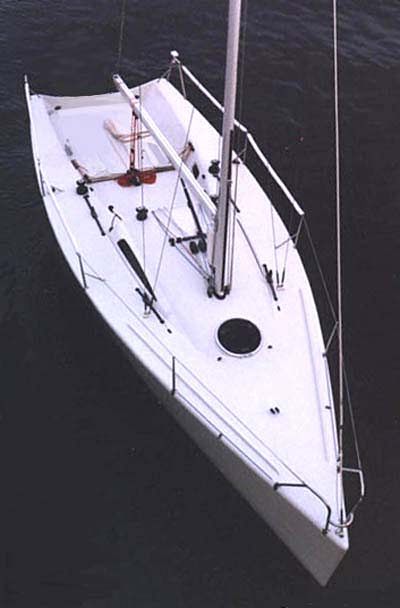 The Donovan 27 can be easily sailed by four people, although a typical racing crew would be 6 or 7. Storage, maintenance and sail replacement costs are reasonable, and towing the boat to a far off regatta is no problem.
The Donovan 27 has a slender, low wetted surface hull shape with a long sailing waterline, generous sailplan, and high efficiency keel and rudder foils, all carefully proportioned in a yacht that yields superior performance in all sailing conditions. Initial sailing trials have demonstrated this design's abilities clearly; high stability and controllability in strong winds, fantastic acceleration, and a hull shape that dampens motion through waves.
Construction: Hull, deck and structure are all built of E-glass, foam core, and epoxy resin. The laminates are vacuum bagged, and there are uni-directional reinforcements in the lower hull panels. The builder specified robust core densities and thickness to obtain high panel stiffness and durability. This type of construction allows for a very simple and reliable framing system resulting in an extraordinarily lightweight structure.
Deck Layout: The deck layout is pure race, based on the hundred or so deck layouts Donovan developed while working at Bruce Farr and Associates. The large cockpit gives you the sense that you're at the helm of a much larger yacht, and crew work benefits from control lines positioned in logical locations that minimizes crew movement and also allows a new crewmember to "learn the ropes" quickly.
Keel and Rudder: High aspect keel and rudder designs with specialized foil sections are carefully crafted to provide maximum lift at the lowest drag. In addition to the 1500 pound lead fin keel, the boat carries 600 lbs of internal ballast to achieve a MORC (Midget Ocean Racing Club) displacement of 4300 pounds. For PHRF or class racing, the internal lead package is easily removable, reducing the displacement to 3700 pounds, to provide spirited downwind performance with little sacrifice to the excellent upwind characteristics.
Rig: The tall fractional rig has a modest topmast height, and a spinnaker hoist two feet above the hounds. This rig configuration rates well in MORC, and is perhaps the best solution for performance in all wind strengths. For PHRF or class racing, a masthead spinnaker may be used. The mast and boom are carbon; it's the best material for these components with fantastic stiffness and structural integrity to provide great rig control for better sail shape. The remarkably light weight of the rig benefits the yachts stability and motion in waves.
Engine: A 20 hp, 3 cylinder Yanmar diesel provides a cruising speed exceeding 7 knots, to get the yacht to and from the starting line with no delay. I prefer boats that are fast all the time.
Jim Donovan grew up sailing in San Francisco and for the past 25 years worked with some of the most talented yacht designers in the U.S., including Bruce Farr, Doug Petersen, and Gary Mull.
After working on hundreds of designs including daysailers, cruising yachts, Grand-Prix racers, Whitbread Round the World Race yachts, America's Cup yachts, and luxury sailing vessels, Jim opened his Annapolis design office in 1995. Current projects include performance catamaran designs ranging in size from 45 feet to 65 feet, mono-hull yachts from 27 feet to 90 feet, and several design upgrades for existing yachts.
Specifications:
| LOA | 27.51 ft. |
| LWL | 23.33 ft. |
| Max Beam | 8.60 ft. |
| Draft | 6.00 ft. |
| Displacement | 4300 lbs. |
JP Donovan Design / James P. Donovan
P.O. Box 4992
Annapolis, Maryland 21403
[email protected] www.donovanyachtdesign.com
MORC website: www.morc.org